
Services
SERVICES
In its commitment to quality R&D&I and excellence in rare disease research, CIBERER offers a range of platforms, including the CBK. CBK provides a portfolio of services designed to offer comprehensive functional support and know-how for research activities.
These services are available to CIBER researchers, public organizations, and the private sector to support basic and applied research in rare diseases. Our ultimate goal is to contribute to the scientific and technological development of society.
-
 Access to Biological Samples
-
 Custody of Biological Samples
-
 Processing
-
 Information Services
-
 Sample Management
Access to Biological Samples
Any researcher wishing to request biological samples from the CBK must complete and attach the following documents:
- Curriculum Vitae of the principal investigator.
- Investigator’s Commitment form.
- Project proposal.
- Approval from the Ethics Committee regarding the submitted project.
- Justification/Financial Guarantee of the project.
The CBK Ethics Committee and Scientific Committee will evaluate the appropriateness of donating the requested biological sample(s) and will issue a report accordingly. Should the decision be favourable, the sample will be sent to the applicant, provided the principal investigator commits to complying with the conditions laid down by current legislation regarding the Data Protection Act and Law 14/2007 on Biomedical Research. The commitment refers to the proper use of the samples, given that they constitute a scarce research material of high scientific value, and to the confidentiality of the information associated with or that may be derived from their study.
Sample requests are processed as follows:
- Via the website, by clicking on the link that allows you to access the CBK researcher portal.
- By post mail after completing the attached documents.

Custody of Biological Samples
Products obtained from donated samples are stored and safeguarded at CBK facilities, adhering to strict biosafety standards applicable to sample processing, storage, and subsequent delivery to the requesting research groups. Their traceability is always guaranteed through a computerized platform specifically designed for the management of human samples (LIMS).
The information provided in the custody request form is stored electronically in the CBK LIMS, complying with all requirements established by current legislation.
PROCESSING
CBK is located in the FISABIO-Public Health building, and comprises four laboratories (sample reception, molecular biology, eukaryotic culture, and quality control/final processing). Our team processes and characterizes multiple types of biological samples according to the procedures and technical requirements used by researchers in their research projects. To access our processing services, please download and complete the following document: Services Request Form Samples for processing should be sent to CBK following the appropriate preservation and transport regulations. (Sample type Collection conditions Storage and dispatch to the biobank pdf
Cellular techniques
- Isolation of peripheral blood mononuclear cells
- Immortalization of B lymphocytes
- Fibroblast culture
- Immortalization of fibroblasts
- Mycoplasma detection
- Detection of SARS-CoV-2 in cell lines
- Plasma extraction
- Myoblast culture
Molecular techniques
- DNA and RNA extraction (peripheral blood, cells in culture, tissue and saliva)
- Quantification of DNA and RNA by spectrophotometry (Nanodrop ONE)
- Genetic fingerprinting (cell lines, DNA)
- DNA integrity analysis
Biological fluid processing
- Serum, plasma and urine
INFORMATION SERVICES
Healthcare professionals who submit a sample to the CBK can benefit from this information service, as we are integrated into the research structure of CIBERER. This information service establishes a mutually beneficial relationship, ultimately benefiting the patients.
Thanks to this service, the referring physician has the option of receiving updated information regarding the disease in question, through CIBERER and Orphanet (European Reference Database on Rare Diseases), whose partner in Spain has been CIBERER since April 2010. Information will also be provided about CIBERER researchers working on this pathology.
SAMPLE MANAGEMENT
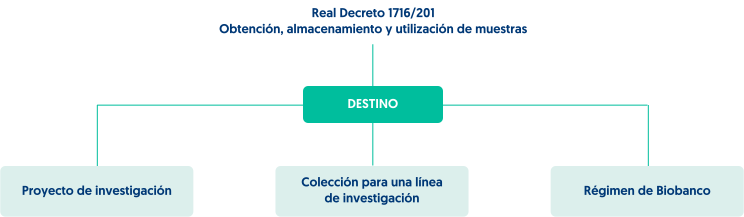
Royal Decree 1716/2011 establishes the basic requirements for the authorization and operation of biobanks for medical research purposes, as well as the handling of human biological samples. Article 22 of this Royal Decree indicates that there are only three basic models for the collection and/or use of human biological samples and their associated data:
- Research Projects
- Collection for a Research Line
- Storage under a Biobanking System
Research Projects:
Biological samples of human origin that are stored outside the organizational framework of a Biobank exclusively for use in a specific research project.
It is important to note that these samples may not be transferred to a third party nor used for purposes other than those established in the project, unless the donor provides new consent for their use with other purposes.
Collection for a Research Line:
This is an organized and intended permanent collection of biological samples of human origin stored outside the organizational framework of a Biobank and intended for use in a specific line of biomedical research.
The informed consent signed by the donor must specify the line of research, the principal investigator, as well as the team and center(s) where the projects will be carried out. The samples may not be used or transferred beyond what is stipulated in the initial informed consent, unless the donor provides a new consent for their use with other purposes.
Biobank Storage:
Biological samples incorporated into a biobank may be used in any biomedical research study, provided the donor has given their informed consent under these terms. Samples may be transferred to third parties without requiring specific informed consent for each transfer. The main objective of the 2011 Royal Decree, which regulated the creation of biobanks for biomedical research purposes, is to facilitate researchers’ access to samples and data that meet quality, preservation, and ethical and legal requirements.
The biobank will transfer human samples to specific projects submitting a request, provided previous approval by an accredited Scientific Committee and Research Ethics Committee (CC and CEI, respectively), as established in Article 12 of Law 14/2007 on Biomedical Research. These committees will evaluate the project in question and the intended use of the requested samples.
| PROJECT | COLLECTION | BIOBANCO | |
| Purposes: Informed Consent | A specific project | A line of research | Any investigation |
| Collaborations | Depends on a new IC | Depends on a new IC | YES |
| Quality Management System | NO | NO | YES |
| Sample Retention Time | Temporary | Temporary/Indefinite | Indefinite |