
About Ciberer Biobank
About us
CIBERER Biobank (CBK) is a national platform supporting biomedical research. We collect, preserve and manage biological samples from people affected by rare diseases, ensuring quality, traceability and ethical access for scientific projects that make a difference.
CBK is part of national and international biobank networks.

- Mission / Structure
- Activities
- Quality Policy
- Frequently Asked Questions
- Colaborations
- Links of Interest
MISSION / STRUCTURE
We are a public, non-profit biobank promoted by the Biomedical Research Network Center for Rare Diseases (CIBERER). Our aim is to facilitate scientific progress through the responsible, centralized management of biological samples and associated data.
We connect patients, researchers and healthcare professionals, creating (building) a bridge between altruistic donation and the generation of scientific knowledge that improves the lives of people with rare diseases.
CBK has the following organisational chart:
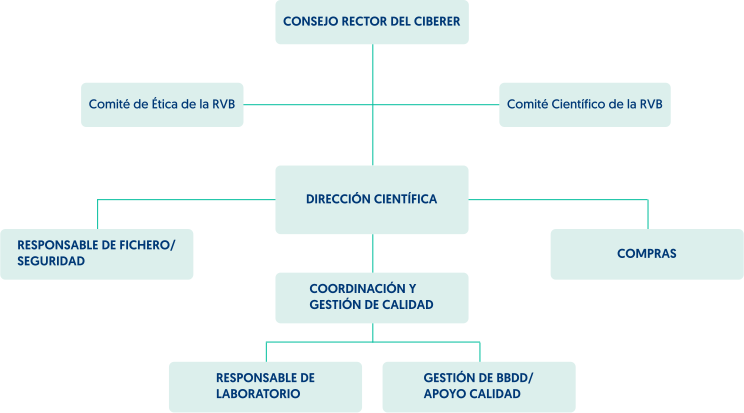
| Scientific director | Dr. Federico V Pallardó Calatayud |
| Deputy director | Dr. José Mª Millán Salvador |
| Biobank coordinator | Dra. Carmen Aguado Muñoz |
| Laboratory manager. | Dr. Salvador Martí Pérez |
| Database manager | Dra. Belén Mollá Moliner |
Ethic Committee: its mission is to ensure compliance with the ethical principles applicable to biomedical research projects using CBK human samples. CBK is attached to the Clinical Research Ethics Committee of the Directorate General of Public Health of The Generalitat Valenciana.
Scientific Committee: evaluates the feasibility and scientific suitability of research projects and approves sample transfers to third parties, advising on sample allocation priorities. CBK is attached to the Scientific Committee of the Red Valenciana de Biobancos (RVB).
ACTIVITIES
- Collection and processing of high-quality samples from patients affected by rare diseases.
- Storage of samples under optimal conditions, ensuring the confidentiality of the samples and all associated data.
- Providing feedback to healthcare professionals or researchers who submitted the sample, and dissemination amongst CIBERER members and other national and international research groups.
- Provision of samples to research groups (public or private), both national and international, which successfully pass the Scientific and Ethics Committee’s assessment of the project for which they are requesting biological samples.
- Promoting and supporting new actions in rare diseases, implementation of new techniques for therapeutic purposes and the development of genetic epidemiology projects.
QUALITY POLICY
To ensure the highest quality in its activities, the Management of the CIBERER Biobank, maintains a Quality Policy with the objective of implementing and continuously improving a Quality Management System compliant with the ISO 9001:2015 standard.
The Biobank Management commits to the following strategic objectives:
- To maximize user satisfaction among research groups requesting stored or processed biological samples through a customer focused approach and personalized attention from CIBERER Biobank staff.
- To ensure that all CBK activities carried are conducted with full respect for human dignity and identity and inherent human rights, while strictly complying with current legislation and international treaties applicable to the processing and storage of biological samples and personal data protection.
- To continuously enhance the effectiveness of the Quality Management System.
- To provide the necessary technological resources for the services offered, ensuring the ongoing motivation and training of Biobank staff.
- To communicate the Quality Policy and objectives to Biobank staff and provide the necessary technical, financial, and human resources required for their achievement. To this end, all CIBERER Biobank employees will receive a copy of the Quality Manual.
- To review the Quality Policy, its objectives, and scope on an annual basis to guarantee its continued suitability.
PREGUNTAS FRECUENTES
- The CBK specializes in rare diseases, thereby ensuring that the samples received are utilized for the most relevant biomedical research.
- The collection, storage and transfer of these samples accelerate the advancement of knowledge leading to better prevention, the discovery of targeted treatments and, eventually, a cure for rare diseases.
- By centralising samples in a single location, we prevent fragmentation across multiple biobanks, which greatly hinders studies requiring a minimum number of cases to be carried out.
- Through the implementation of a Quality Management System, CBK guarantees the integrity, scientific value and traceability of all biological samples.
- CBK is committed to promoting sample usage by distributing them to research groups that will maximize their scientific impact. CBK’s integration into biobank networks will contribute to this work.
- CBK aims to foster collaboration with healthcare professionals by updating them on the scientific achievements of the ongoing research projects they help to support.
- The CBK forms part of the CIBERER’s research structure and utilises its full potential to disseminate and use samples to their fullest potential.
There are many ways to define a biobank. According to the Biomedical Research Act (Act 14/2007 of 3 July), it is a public or private, not-for-profit organisation that houses a collection of biological samples for diagnostic or biomedical research purposes. It operates as a technical unit in accordance with specific criteria for quality, traceability and intended use.
In practice, a biobank is a research support platform that connects donors, clinicians and researchers, ensuring the safe and efficient management of biological samples and associated data.
Its primary purpose is to promote and facilitate studies across various areas of biomedical research, playing a fundamental role in the development of personalised medicine.
The CIBER is a public consortium established on the initiative of the Carlos III Health Institute (ISCIII). It comprises 13 thematic areas, amongst which the Rare Diseases area was created to act as a centre of excellence, coordinate and promote research into these conditions in Spain.
The Rare Diseases area (CIBERER) comprises 50 research groups, linked to a variety of institutions (university hospitals, universities, public research bodies, etc.), which make up the consortium. These research groups form the basic operational units and are grouped into seven scientific programmes. With this network structure, CIBERER stands as a pioneering initiative designed to foster synergies between leading groups and institutions in different areas and disciplines within the field of rare diseases.
Rare diseases are conventionally defined by their low prevalence in the population. This has been agreed to be a prevalence of fewer than 5 per 10,000 inhabitants. However, the concept of a rare disease is broader and refers to rare, chronic and generally severe conditions with limited treatment options.
In a high proportion of these diseases, the primary cause is genetic in origin; hence the great importance of genetics as a science and of the genetic approach to understanding fundamental aspects of medicine and clinical practice for this group of diseases.
Colaboraciones
1. Organisations
-
 Fundación para el Fomento de la Investigación Sanitaria y Biomédica de la Comunitat Valenciana, FISABIO
 -
 Banco Nacional de ADN
 -
 Red Nacional de Biobancos
 -
 Orphanet España
2. Patient organisations
-
 AFASW
AFASW -
 ENACH
ENACH -
 Asociación DDX3X España
 -
 ADECYL
 -
 Asociación CTNNB1
 -
 Quistes de Tarlov
 -
 AESTBR
 -
 Sindrome de Persona Rígida